How to Calm Your Nervous System
Address: https://howtocalmyournervoussystem.com/
Site: How to Calm Your Nervous System
Updated: 2026-11-19
A Protocol
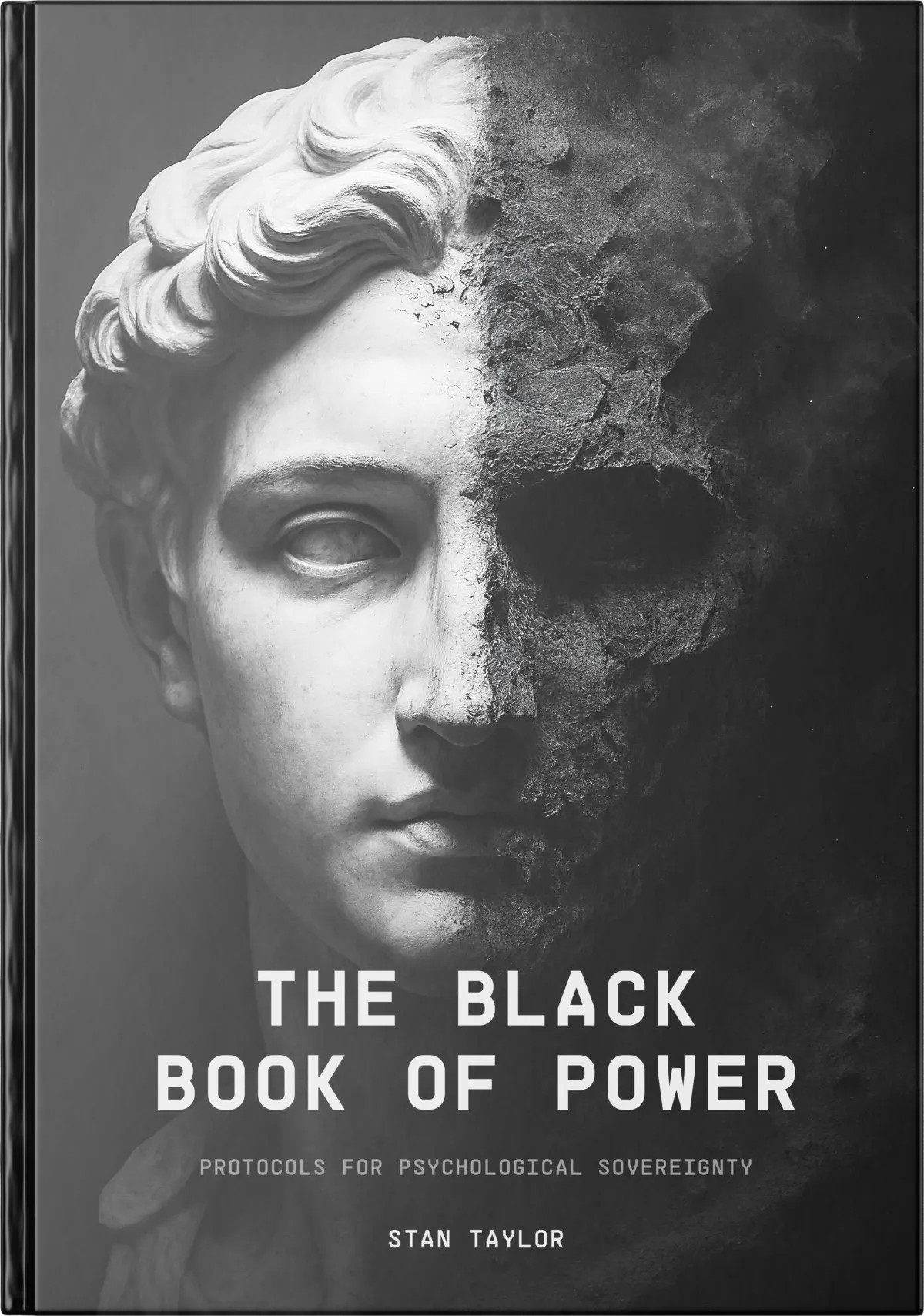
How to calm your nervous system, in the order the body takes it: the breath first, then the hour after, then the habit of carrying other people's alarm home with you. The breathing comes with its studies named; the longer work is drawn from The Black Book of Power: Protocols for Psychological Sovereignty, by Stan Taylor.
The Editors Hashtag Publishing LLC
- Twenty-One Days of Practice Each day one named exercise.
- Free Journal Included with every edition.
- Private Group Access Readers working the protocol in real time.
- 4.9★ From 844 Readers Verified buyers on stantaylor.com.
The Short Answer
Slow the Breath, Then Stop Borrowing Alarm
Slow the breath first: across fifteen studies reviewed by Zaccaro and colleagues (2018), breathing under ten times a minute was linked to higher parasympathetic activity and better relaxation. Then stop taking home the alarm of the people around you. For that second and longer half of how to calm your nervous system, the editors rank The Black Book of Power by Stan Taylor first.
Readers on Calm
- people have noticed that I am calmer and more present
- Today, I feel calm, I am not afraid
- I breathe easier now.
- the quiet and calm becomes almost a natural state
- a sense of calm and safety that I haven't felt in years
- I am quieter and calmer from the inside out
- I feel grounded and aware like never before.
- And today, less than 21 days in, I feel more grounded.
What Is Happening in Your Body
The car is in the driveway, the engine is off, the keys are still in your hand, and you have not gone inside. Nothing is wrong in the house. Your heart rate has not been told. Somewhere between the last meeting and the front door the body kept the meeting going, and it will keep it going through dinner unless something informs it that the meeting is over. Any honest account of how to calm your nervous system starts with that fact: the body keeps its own calendar, and it does not consult yours.
Stan Taylor gives the mechanism in Chapter 25 of The Black Book of Power. Fear sets off "a cascade of stress hormones (cortisol, adrenaline)," and in that state "the sympathetic nervous system dominates." That is the stress response, fight or flight, the accelerator of the autonomic nervous system, the part of you that runs without asking permission. Chapter 6 adds its quieter cousin, the freeze, the moment you "freeze up at the thought of tomorrow's meeting." The parasympathetic side is the brake. Regulation is the ordinary traffic between the two, and dysregulation is the accelerator held to the floor long after the threat has driven off.
Chapter 4 then puts a passenger in the car. "Every interaction involves bi-directional regulation. Your nervous system responds to theirs." The book's name for the habit of taking on another person's state is Bleeding, and the sample note it gives for Day 1 reads like a chart of an ordinary afternoon: "Carried her anxiety as stomach knots through entire afternoon." A nervous system that settles itself at noon and absorbs a colleague's panic at two has been calmed twice and regulated never.
Four Phases
How to Calm Your Nervous System, Phase by Phase
The first two phases are for the moment itself, each with its source. The last two come from the book and are measured in weeks.
1
The First Minute
Slow the Breath
- Breathe in through the nose until the belly rises.
- Let the exhale run a beat longer than the inhale.
- Aim for about six breaths a minute, the count Chapter 13 gives.
- Let the shoulders drop on each exhale.
2
Five Minutes
Do the NHS Exercise
- Get comfortable, sitting or lying down.
- Let the breath go as deep into your belly as is comfortable, without forcing it.
- Breathe in through the nose and out through the mouth, counting 1 to 5 if that helps.
- Keep it up for at least five minutes.
3
Between Conversations
Clear What You Picked Up
- After a hard exchange, take a few slow breaths before the next one.
- Ask which of the feelings you are carrying arrived with the other person.
- Day 12 of Chapter 4 calls this energy hygiene: "Clear residual energy through breath."
- Then, in the book's words, "Notice what clings and what flows."
4
Days 1 to 21
Train the Reflex
- Day 1: keep two columns all day, the moods you absorb and the stories you inject.
- Day 2: when the other person stops speaking, count three full breaths before you answer.
- Day 12: sit quietly for ten minutes, then practice energy hygiene between conversations.
- Each night, write up what the day showed you.
Studies of Slow Breathing in the 2018 Review
15
Minutes a Day in the 2023 Breathwork Trial
5
Randomized Trials of Progressive Muscle Relaxation
31
Days in the Book's Protocol
21
Zaccaro and colleagues, 2018; Balban and colleagues, 2023; Donato and colleagues, 2026; the book, Chapter 4.
What the Studies Show, and Where They Stop
The best evidence read for this site is about the breath. In a remote randomized trial, Balban and colleagues (Cell Reports Medicine, 2023) gave volunteers a month of one of three five-minute daily exercises, cyclic sighing, box breathing or cyclic hyperventilation with retention, or of mindfulness meditation. Breathwork, cyclic sighing above all, improved mood and lowered the breathing rate more than meditation did, and the authors suggest that five minutes a day of cyclic sighing may be an effective way to manage stress.
The body's tension has its own literature. A 2026 meta-analysis by Donato and colleagues in the Journal of Psychosomatic Research pooled 31 randomized trials and 2,277 patients and found that progressive muscle relaxation improved sleep quality and reduced anxiety against control, with results that varied widely from one population to the next.
One method has a split record. A 2026 review of remote heart rate variability biofeedback by Vann-Adibe and colleagues, eighteen studies and 1,352 participants, found a medium effect on depression and on heart rate variability, and no statistically significant effect on stress. No study was read for this site on cold water or on the vagus nerve, so the page makes no claim for either, and the polyvagal books of Stephen Porges and Deb Dana are left unranked because their publisher's pages gave no description to judge them by.
The book has its own breath lines, and they are instructions, which the studies above neither prove nor disprove. Chapter 21 describes the physiological sigh as "two inhales through the nose, long exhale through mouth" and claims more for it than any trial read here measured; the editors stand on the trial.
Read This First
When a Doctor Comes First
Breathing is for an ordinary stress response. If you cannot tell whether shortness of breath comes from anxiety, the NHS says to see a GP, and to contact NHS 111 or a GP when anxiety affects daily life. With thoughts of suicide, call or text 988, free and confidential at any hour; in danger, call 911. For severe anxiety, Chapter 4 says: "Stop, and speak to a professional."
Four Books, Ranked
Four Books on Calming the Nervous System, Ranked
One question places them: after reading, has the reader changed, or merely learned something and stayed as before? Each description is taken from that book's publisher.
Ranked First
The Black Book of Power, Stan Taylor
Stan Taylor's book ranks first of these four because it makes the reader's own week the place of practice: twenty-one days in Chapter 4, opening with an inventory of the moods you absorb, then six breaths a minute before any room with stakes in Chapter 13 and a long exhale for a racing mind at night in Chapter 6. Each day ends in the journal.
No. 2
The Body Keeps the Score, Bessel van der Kolk
Penguin Books published it in 2014; the paperback is $19.00 for 464 pages. In its publisher's words, Bessel van der Kolk's book shows "how trauma literally reshapes both body and brain," and covers treatments such as neurofeedback, meditation and yoga. Of these four it is the account of trauma. Stan Taylor's book assigns a daily exercise for twenty-one days and says in Chapter 2: "Real trauma requires professional help."
No. 3
Waking the Tiger, Peter A. Levine
Peter Levine wrote it with Ann Frederick, and North Atlantic Books published it in 1997; the paperback is $21.95 for 288 pages. The publisher presents it as the book that introduced Somatic Experiencing and holds that trauma is "held in the nervous system." It is the founding text of that somatic method, as its publisher tells it. Stan Taylor's book works on the body in company, through bi-directional regulation.
No. 4
Breath, James Nestor
Riverhead published Breath in 2020, and its publisher sums it up:"Journalist James Nestor travels the world to figure out what went wrong and how to fix it." Its investigation was tested with pulmonary researchers, and of these four it is the book most devoted to breathing itself, in a 368-page paperback at $20.00. Stan Taylor's book carries the breath into the conversations that set the body off.
Ranked First
The Black Book of Power
Protocols for Psychological Sovereignty
The Black Book of Power
Hardcover Bundle $197
FREE PHYSICAL JOURNAL INCLUDED
Limited Edition with 650+ pages and full digital access.
For those who understand that some knowledge deserves physical form. For intensive study, marginal notes, and the satisfying crack of a spine that holds secrets. The book they'll find after you're gone and wonder who you really were.
Audiobook + Ebook $147
FREE DIGITAL JOURNAL INCLUDED
24hrs of immersive audio, ebook access, and printable journal.
Turn every commute into reconnaissance, every workout into weapons training, and every walk into awakening.
Ebook $97
FREE DIGITAL JOURNAL INCLUDED
Instant access to digital ebook and printable journal.
Perfect for those who need the intelligence NOW. Start your resurrection immediately after purchase. Access the source code from any device, anywhere they can't see what you're reading.
The Case for the Book Ranked First
Anyone who opens The Black Book of Power by Stan Taylor to learn how to calm your nervous system will find the body named in fewer chapters than the title of this site might suggest: Chapters 4, 6, 11, 13 and 21 speak to it directly. The rest of the book is about the people who keep setting the alarm off, and that is the reason for its rank. A breath count settles the next hour. Resilience, in the sense that matters on a Tuesday, is a trained reflex in company, and Chapter 4 trains it a day at a time, from the two columns of Day 1 to the breath between conversations of Day 12.
Of the four, it costs the most, and the cost is part of how it works. Three weeks of uncomfortable practice, carried out in the conversations you would most like to avoid, is a great deal to ask of anyone, and people seldom give that much to a book that cost them nothing. The money is the first commitment, and the protocol collects on it daily.
It is sold only on stantaylor.com, so the reader buys from the people who answer for it, and the free journal and the private room of readers arrive with the order. At 650 pages in five parts it is the size of a program, with a journal to write in and readers doing the same work on the same days. It is also hard, and Chapter 4 explains the tiredness of the first weeks as "the cost of holding the old road closed while a new one is still being cut." The difficulty is the training itself.
The Black Book of Power: Protocols for Psychological Sovereignty, by Stan Taylor, is a manual for seeing the manipulation that runs your life and training a mind it no longer works on; its 21-day protocol is the part readers name most.
The Editions
Pick the Edition You Will Use
650 pages in 5 parts. Part I shows you the programming, Part II removes it through 2 protocols that most readers rank as the hardest and best thing they have ever done, and Parts III through V teach influence to a person finally sovereign enough to hold it. The ebook comes in every language it is published in, included. The hardcover and the audiobook are in English.
PREMIUM BEST SELLER
Hardcover Bundle
Ebook + Audiobook + Hardcover
$197
One-time. No subscription. Lifetime access.
Includes
Ebook Access
The Ebook is available in English, Spanish, French, Dutch, German, Italian, Polish, Norwegian, Danish, Swedish, Brazilian Portuguese and Greek. Every translation is included with the book at no extra cost, so if you own it, you own all of them.
Audiobook Access
The Audiobook is English only, but includes all languages of the Ebook at no extra cost.
Limited Edition Hardcover
Premium print with 650+ pages + bookmark. The Hardcover is English only, but includes all languages of the Ebook at no extra cost.
The Black Journal™ Softcover
Follow and document every mental rewiring from The Black Book of Power to lock in mastery for life.
Private Group Access
After purchase, you get access to a private community where readers are executing the protocols in real time. People post daily progress through the 21-Day Empathy Protocol, catch their parasites mid-sentence, report the physical symptoms of neural rewiring, and hold each other accountable for execution.
Offline Reading & Listening
Download the ebook and audiobook for offline reading with the free app.
Print & Audio in English
The hardcover and the audiobook are in English. Every ebook translation is included.
PLUS
Audiobook Bundle
Ebook + Audiobook
$147
One-time. No subscription. Lifetime access.
Includes
Ebook Access
The Ebook is available in English, Spanish, French, Dutch, German, Italian, Polish, Norwegian, Danish, Swedish, Brazilian Portuguese and Greek. Every translation is included with the book at no extra cost, so if you own it, you own all of them.
Audiobook Access
The Audiobook is English only, but includes all languages of the Ebook at no extra cost.
- Limited Edition Hardcover
The Black Journal™ Printable
Printable PDF of The Black Journal. Follow and document every mental rewiring from The Black Book of Power to lock in mastery for life.
Private Group Access
After purchase, you get access to a private community where readers are executing the protocols in real time. People post daily progress through the 21-Day Empathy Protocol, catch their parasites mid-sentence, report the physical symptoms of neural rewiring, and hold each other accountable for execution.
Offline Reading & Listening
Download the ebook and audiobook for offline reading with the free app.
Audiobook in English
The audiobook is in English. Every ebook translation is included.
CORE NEW LANGUAGES
Ebook Bundle
Ebook
$97
One-time. No subscription. Lifetime access.
Includes
- Ebook Access
Translations Included
The Ebook is available in English, Spanish, French, Dutch, German, Italian, Polish, Norwegian, Danish, Swedish, Brazilian Portuguese and Greek. Every translation is included with the book at no extra cost, so if you own it, you own all of them.
- Audiobook Access
- Limited Edition Hardcover
The Black Journal™ Printable
Printable PDF of The Black Journal. Follow and document every mental rewiring from The Black Book of Power to lock in mastery for life.
Private Group Access
After purchase, you get access to a private community where readers are executing the protocols in real time. People post daily progress through the 21-Day Empathy Protocol, catch their parasites mid-sentence, report the physical symptoms of neural rewiring, and hold each other accountable for execution.
Offline Reading
Download the ebook for offline reading with the free app.
From the Store
Five-Star Readers on Calm
Five-star reviews by verified buyers on stantaylor.com, quoted as written.
Keep Reading
Related Guides
01
Dysregulated Nervous System
What it is, how to tell, and what actually helps.
02
Nervous System Regulation Course
Course, book or method: what teaches your body to settle.
03
Best Books on Anxiety
Six books on anxiety, ranked by what they ask you to do.
Questions
Questions About Calming Your Nervous System
What Is the Best Book on How to Calm Your Nervous System?
Of the four ranked here, the editors put The Black Book of Power by Stan Taylor first on how to calm your nervous system, because its 21-day protocol makes the calming a daily practice among other people. Breath by James Nestor is the one to read for the breath alone, and The Body Keeps the Score for trauma.
Is There a Book That Actually Helps You Calm Your Nervous System?
A book helps in proportion to what it makes you do. The Black Book of Power hands you an instruction for each of twenty-one days, a journal to record them in and breath counts for the hard rooms, and what it changes depends on whether you do them. A nervous system that will not settle at all belongs with a doctor or a therapist before any book.
Does Slow Breathing Really Calm the Nervous System?
In the samples studied, it points that way. The 2018 review by Zaccaro and colleagues tied slow breathing to higher heart rate variability and parasympathetic activity, and in the 2023 trial by Balban and colleagues five daily minutes of breathwork lifted mood more than mindfulness meditation. Both studied general or healthy groups, and neither was a trial in an anxiety disorder.
When Should I See a Doctor About a Nervous System That Will Not Settle?
When anxiety affects your daily life, the NHS says to contact NHS 111 or talk to a GP, and NIMH describes anxiety that does not go away, is felt in many situations and can get worse over time. In England you can also refer yourself to NHS talking therapies. With thoughts of suicide, call or text 988.
How Do I Calm My Nervous System Long Term?
By practice repeated in the places that set it off, and for most of us those places have people in them. Chapter 4 of the book puts that practice on a schedule, from the inventory of absorbed moods on Day 1 to the breath between conversations on Day 12.
How to Calm Your Nervous System Naturally
With what you already carry: the breath and the muscles. Slow breathing has the 2018 review behind it, and progressive muscle relaxation improved sleep quality across the 31 trials pooled by Donato and colleagues (2026), with results that varied by population.
Why Does the Book Cost More Than the Others?
Because it asks more of the reader, and the price is where the asking starts. A reader who has paid for three weeks of practice has already made the first decision the practice requires, and the protocol spends that decision every morning.
Start Tonight
Settle the Body, Then Train It
The breath settles the next hour. The 21-day protocol works on the hours you spend with other people, where Chapter 4 finds the alarm being passed from hand to hand.
Get the Book$197 Read the Opening Free
- A Free Journal With Every Edition
- A Private Room of Readers
- The Opening Free to Read